

As recently as 30 years ago, many people felt confident relying on the Farmer’s Almanac to look at historical weather conditions for a specific region and day to make decisions as important as whether it was safe to have an outdoor wedding the same day the next year. That’s because the weather used to be far more consistent and reliable than it is now.
An increasingly volatile climate is upending once-reliable predictions that aren’t just important to people planning weddings, but to entire industries that now find themselves paying significantly closer attention to both day-to-day and extreme weather conditions that affect their operations and output.
The nation’s weather infrastructure, however, was originally built to account for the time when weather was relatively more reliable. When the federal government built its NEXRAD radar network several decades ago, for instance, it spaced its long-range (or S-band) systems roughly 150–200 miles apart. Trying to accurately cover this much ground with a single radar inevitably resulted in large swathes of land with blind spots. At the time, it might have been safer to assume that people who lived and worked in these “radar gaps” could get a pretty good sense of what the weather would look like from nearby weather reports.
Fast forward to today, a lack of visibility into these gaps is resulting in a lack of insight into weather conditions across more than 60% of the United States landmass. But filling these gaps alone does not solve the entire weather visibility problem.
For companies whose operations and performance are directly affected by local weather conditions–think energy grid operators and traders, insurers, farmers, and transportation companies–knowing weather conditions down to street level, in real time and over time, has become critical to keeping communities safe and turning a profit. Many of these industries, such as the utilities that power millions of homes and companies, have historically operated on general estimated forecasts, rather than the local and real-time weather conditions that influence energy production and grid capacity.
Gaining this level of granularity requires more than publicly available weather data; it calls for an entire “weather tech stack” that consists of supplemental data from one or several more private sources. Another layer in these stacks is technology that can process massive amounts of data and understand the direct implications of upcoming weather events on a company’s operations.
A company called Climavision is at the center of a push toward dedicated weather operations.
One company, Climavision, aims to be a central component to these weather tech stacks, serving not only as a new source of radar data that sees into gaps in the NEXRAD network, but also providing software that can ingest data from any number of public and private data sources to deliver real-time and long-term weather insights into hyper-local and global weather conditions.
Since its $100 million Series A in 2021, Climavision has evolved from a high-potential concept into a scaled, operational weather-intelligence platform.
-

Chris Goode, CEO and Founder of Climavision
According to the company’s founder and CEO, Chris Goode, its model is one part radar data and another part software that produces far more granular visibility into emerging weather events than previously available.
Climavision is building a proprietary radar network across the country, already with 29 operational systems and over 40 partnerships in 14 states. (Florida will become the 15th state this year, with four radars already slated to be installed.) It’s additionally developed a suite of high-resolution–and in some cases, AI-enhanced–forecast models that are now in use by utilities such as CenterPoint Energy, energy traders and platforms like Enverus, media groups, and government agencies.
“Our AI modeling platform delivers sub-seasonal and seasonal forecasting capabilities, meaning our customers can plan weeks to months ahead with a level of precision that legacy systems don’t offer,” explained Goode.
While Climavision’s radar network and forecasting models are designed to reinforce one another, Goode says that their models are built to ingest far more data than that from their gap-filling radars. “We pull in a wide spectrum of ground-based, atmospheric, and remote-sensing data–everything from surface stations and mesonets to partner sensors and satellite inputs.”
Federal and local governments’ roles in tracking the weather are changing.
Meanwhile, the federal government is responding to the changing nature of the weather through public-private partnerships that let it fill visibility gaps that its current network of radars, balloons, satellites, and other equipment can’t see at the granular level now necessary.
-
![]()
A crane installing one of Climavision’s radars on a water tower in Americus, Georgia.
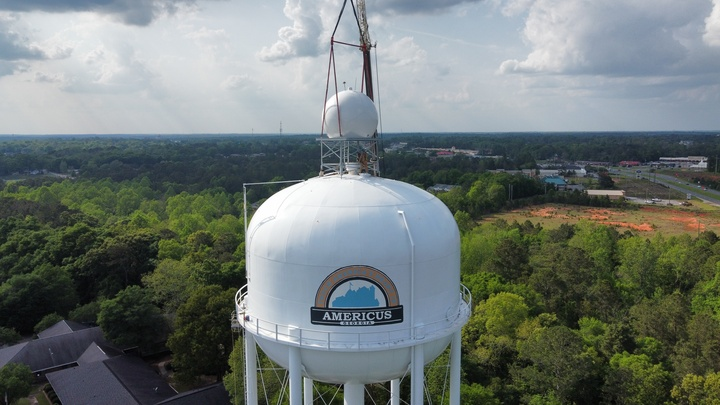
“NOAA and the National Weather Service do an extraordinary job with the resources they have, but they’re working with an aging observation network that wasn’t built for the frequency, severity, or geographic distribution of today’s weather,” shares Goode.
Local and federal agencies aren’t filling these gaps directly because building, operating, and maintaining modern radar (or other) systems requires substantial capital, specialized technical expertise, and long-term operational funding resources that are often constrained or directed elsewhere.
The Public–private partnership model is also becoming essential in the weather space because the operational risk profile in this country has changed faster than the federal infrastructure can.
A private company like Climavision can move faster, invest differently, and plug critical gaps that government systems simply can’t address on their own.
When it comes to radar coverage, the national NEXRAD network cannot see severe storms and other hazardous conditions like flooding, snow squalls, and damaging winds that form or intensify below the federal radar beam. This matters to emergency managers, public safety, utilities, transportation operators, and the public. By the time these events are detectable, operators may already be behind the curve.
Climavision’s supplemental radars provide this low-level visibility, tightening detection windows and improving lead times for severe weather.
“In these situations,” says Goode, “the community gains critical situational awareness, and those same observations are fed into their national modeling suite to elevate accuracy for private users downstream.”
According to him, that’s a “text book public-private partnership.”
The Impact of Weather on Different Industries
Weather risk is no longer episodic; it’s structural. Nearly every industry now faces frequent, costly weather disruptions, and the financial footprint of these events continues to balloon. In just the past year, the Texas hail season generated more than $4 billion in damage, Mid-Atlantic flooding climbed into the multi-billion-dollar range, and major hurricanes like Helene delivered tens of billions in losses.
According to Goode, these aren’t outliers – they’re becoming the new baseline.
At the same time, the limitations of aging federal radar infrastructure and inconsistencies in government data inputs have become more visible. While it’s a sensitive point, operators across the public and private sectors are increasingly recognizing that traditional systems alone can’t keep pace with today’s risk environment. As a result, weather has moved from a background variable to a board-level priority. Companies, utilities, and local governments are now putting weather at the center of their operational, financial, and resilience planning.
Texas-based CenterPoint Energy is a good example of a utility that completely transformed its operations using Climavision’s advanced AI-enhanced weather modeling after Hurricane Beryl resulted in widespread devastation and $7.4 Billion in damages to regional communities and energy infrastructure.
The company has since placed weather operations central to its decision-making and introduced operational forecasts that reflect moment-by-moment conditions happening in its direct grid footprint. Through a continuous, hyper-local stream of weather intelligence, the CenterPoint team can see severe convective activity forming between radar gaps, anticipate power restoration risks with greater precision, and position crews based on forecasted storm severity at the neighborhood level. It has the data it needs to keep crews safe in the event of a prolonged storm response effort.
According to Goode, the need for far more sophisticated weather tech stacks spans a number of industries that affect millions: farmers and agriculture companies need to know the weather to optimize food production. Logistics and transportation companies need to optimize routes for both efficiency and safety. Insurers need to know if they can profitably insure different regions of the country and how to effectively price dangerous zones without over-pricing their customers.
Other fast-emerging use cases for weather technology include states’ and companies’ ambitions for introducing commercial drones, autonomous vehicles’ need for granular weather data, and energy companies’ need to optimize energy output to meet AI and data warehouse needs.
The idea of a weather tech stack might not be something a company ever considered, but the case Goode and Climavision are making for it is certainly compelling.
Jordan French is the Founder and Executive Editor of Grit Daily Group , encompassing Financial Tech Times, Smartech Daily, Transit Tomorrow, BlockTelegraph, Meditech Today, High Net Worth magazine, Luxury Miami magazine, CEO Official magazine, Luxury LA magazine, and flagship outlet, Grit Daily. The champion of live journalism, Grit Daily’s team hails from ABC, CBS, CNN, Entrepreneur, Fast Company, Forbes, Fox, PopSugar, SF Chronicle, VentureBeat, Verge, Vice, and Vox. An award-winning journalist, he was on the editorial staff at TheStreet.com and a Fast 50 and Inc. 500-ranked entrepreneur with one sale. Formerly an engineer and intellectual-property attorney, his third company, BeeHex, rose to fame for its “3D printed pizza for astronauts” and is now a military contractor. A prolific investor, he’s invested in 50+ early stage startups with 10+ exits through 2023.


